
Eight suites that run the whole school

Teacher first: 10+ AI tools with CBSE and ICSE content
Explore Assist →
From the first doubt to the chapter exam, one connected path
For Class 3 to 12, CBSE and ICSE, with JEE and NEET for Class 11 and 12. Every chapter in four steps.
Where would you like to sign in?
School login
For staff and admins · app.schoolcanvas.com
Student login
For students · student.schoolcanvas.com
Popular with schools
Popular with students and parents
Your study partner from Class 3 to 12.
Learn, practise, take the exam and revise every chapter in one app, with Guruji to answer any doubt in English or Hinglish.
- Class 3 to 12 · CBSE and ICSE
- JEE and NEET for Class 11 and 12
- 30-day free trial




Find your weak spot in two minutes.
Four questions from Class 10 Science, Chapter 11: Electricity. Answer them the way you would in a school test, and see the report you would get in the app, concept by concept.
- 1A result for every idea, not one markEach question checks one concept, so you see exactly which part of the chapter you know.
- 2Your gap gets a nameThe report tells you which concept is weak, and which older topic may be behind it.
- 3Guruji explains itA short, step-by-step explanation of what you missed. In the app, practice rounds follow until you have fixed it.
Every answer you give tells a story. A right answer shows what you have mastered, a wrong one shows a gap, a repeated mistake shows a pattern, and a better attempt shows you are improving. The app reads them together to work out what you need next.
A good doctor doesn't give every patient the same medicine.
Five people walk into the same clinic, and the doctor treats each one differently. You and your classmates sit through the same chapter, but you don't come out with the same understanding, gaps, memory or pace. So why should you all study it the same way?
Same chapter. Which one are you today?
Still confused
You need the concept explained again, more simply.
Almost there
You understand it, but need more practice on the same idea.
Ready for more
You are ready for application and higher-order thinking questions.
Missing a step
You need to go back to a concept from an earlier class first.
You can be all four in one chapter, one concept at a time. The app works out which, and changes your path as you improve.
Find your class. The app grows with you.
In Class 4 you want learning to stay fun. In Class 8 you want your gaps found before they pile up. In Class 10 you want board-pattern practice, and in Class 12 you are preparing for the boards and an entrance exam at once. Schoolcanvas Learn changes with your stage.
 Class 3 to 5
Learn together, without the pressure.
At this age your child is learning to read with understanding, to be comfortable with numbers and to ask why. Short lessons, a question in the middle of each video and quizzes with no timer let them learn a little every day, with you close by. The habit matters more than the marks, and a gap closed now, in place value or reading, doesn't follow them for years.
A bus has 6 rows with 4 seats in each row. How many children can sit in the bus?
Answer: 24. If your child is stuck, a picture of the rows helps them see it.- Short videos that stop to ask your child a question
- Notes with pictures, and bigger text in one tap
- Five-question quizzes with no timer, and a hint when stuck
- Flashcards to go over a chapter together
- Olympiad practice if your child enjoys a challenge
For parents: A weekly summary, and one simple tip on how you can help at home.
 Class 6 to 8
From knowing a topic to using it.
Subjects get more detailed, and questions start asking you to apply what you know. This is also when gaps quietly pile up: if negative numbers or fractions were never quite clear, they come back later as mistakes in equations and ratios. The app spots that early, so one old gap doesn't keep costing you marks.
(−3) × (−4) = ?
Options −12, 12, −7, 7. Get it wrong and integers are marked as a weak concept, and your plan adds a short refresher.- Chapter worksheets that show which of your concepts are weak
- Old gaps traced back to earlier classes, with a short refresher
- New practice questions only on your gaps, until you reach 80%
- Case-based and assertion–reason questions, so you get used to them early
- Olympiad practice, and Guruji for homework doubts
For parents: Which concepts your child fixed this month, and which are still being worked on.
 Class 9 and 10
Board-ready, chapter by chapter.
Topics get deeper, and board papers test understanding, not memory: a large share of questions are case-based or competency-based, and long answers need the right points to earn full marks. Steady practice through the year will help you more than a last-minute rush before the board exam.
A feather and a coin are dropped together in a tube with the air pumped out. Which reaches the bottom first, and why?
Both together: without air resistance, all objects fall with the same acceleration.- Worksheets in the board pattern: case-based, assertion–reason, competency-based
- Past-year, NCERT and exemplar questions in the question bank
- Your written answers checked point by point, with a full-marks model answer
- Full practice papers in the board pattern, against the clock
- Mind maps and formula sheets for revision week
For parents: How ready your child is for the next school exam, chapter by chapter, in a monthly report.
 Class 11 and 12
Boards and JEE or NEET, from the same chapter.
The pace jumps, and if you take science you are probably preparing for the boards and an entrance exam at the same time. The route that works: master each NCERT chapter for the boards first, then practise it in JEE or NEET style, and take full-length tests regularly to build speed and accuracy. Any weak Class 9 and 10 basics are found and fixed along the way.
If the roots of x² − 7x + k = 0 differ by 3, find the value of k.
Answer: 10. In a numerical question there is no negative marking, and the test screen tells you so.- Each NCERT chapter for the boards first, then practice in JEE or NEET style
- Past-year JEE and NEET questions, chapter by chapter
- Test series on fixed dates in the real computer-test pattern, with negative marking
- After every test: your time per question, marks lost to guessing, chapters to fix
- Open to you whatever your board, including state boards
For parents: Your child's score trend across mock tests, subject by subject, and the next test date.
CBSE and ICSE. JEE and NEET preparation is open to students of every board, including state boards. State board school subjects are coming soon.
Homework, a doubt, a test tomorrow. Sound familiar?
Meet Vedant, in Class 10. Science today was Electricity, one part of it didn't make sense in class, and there is Maths homework too. Here is one ordinary evening with Schoolcanvas Learn. Vedant is an example; the evening could be yours.
He picks up exactly where he stopped
The home screen opens on the video he paused yesterday. At 3 minutes 40 seconds the video stops for a quick question: how is current measured in a circuit? He answers, and the lesson carries on. That one answer already tells the app something about what he knows.
One line in the notes doesn't make sense
He selects "the same potential difference across each resistor" in the notes. Guruji explains it in a panel at the bottom of the page, in plain words, without taking him out of the notes. No waiting until tomorrow to ask.
The worksheet finds what a single mark would have hidden
He scores 4 out of 5 in the chapter quiz and feels fine. Then the 20-question worksheet: 65%. Three concepts are fine. Resistors in parallel is at 30%, and the app traces it back to adding fractions, a Class 7 Maths topic he never quite got.
Two short rounds, and the gap is closed
A 6-minute refresher on adding fractions, then two rounds of new questions only on resistors in parallel. 58%, then 84%. The chapter exam opens, and he goes to bed knowing he is ready for it.
Maths homework, and one stubborn minus sign
Stuck on a pair of linear equations, he photographs his own working. Guruji checks it line by line: lines 1 and 2 are right, line 3 has −24 written as 24. He fixes it himself. Three sign questions are added to his plan, because the same slip showed up in his worksheet last week.
His mother sees the week, not the chats
The weekly summary shows 5 hours 40 minutes of learning and three chapters done, with one tip: ten minutes of negative-number practice together would help his Maths. His doubts to Guruji stay private.
What if studying could respond to you?
Not just give you content, and not just tell you right or wrong, but understand where you are, what you need and what will help you move forward.
Get curious, go deeper
Questions inside the videos, quizzes and visuals make a chapter something you want to explore, not just finish.
Don't just answer, think
Questions move from remembering to applying, analysing and reasoning, so you understand the idea, not just the answer.
Know what to do next
Feedback comes straight away: what you understood, where you went wrong and what needs more practice.
Stuck? You're not alone
Ask Guruji for a hint, step-by-step help or the right video, and work out the answer yourself.
Your pace, your path
Need more time? Go back. Need more practice? Practise. Ready? Move on. Nobody is waiting for you or rushing you.
See your learning, not just marks
Your strengths, weak concepts, repeated mistakes and progress, so you know exactly where to put your effort.
Learn, Practise, Exam, Revise. Every chapter, the same four steps.
Each step opens the next, so you never just watch a chapter and forget it. Scroll through one chapter, Electricity, from your first video to the night before your test, or read our guide on how to revise a chapter at home.
-
01 Learn Video lessons
Concept by concept, with videos that stop to ask you
You go through each chapter one concept at a time, in order, following NCERT and your syllabus. If a concept depends on something from earlier, a short bridge comes first, so you are never lost. Animated videos make each idea easy to picture, and every few minutes the video pauses to ask you a quick question.
- Quick questions inside the video. Answer on the spot. From the first minute, your answers show the app what you have understood.
- Animated, in English and Hinglish. Hard ideas broken into small, visual pieces. Pause, replay and go back to any concept, whenever you like.
- Recorded sessions, any time. Missed a point in class, or want it explained again? Watch a recorded session when it suits you.
- Live classes with expert teachers. When you need a deeper explanation or want to ask questions, join a live class.
Why it matters. Watching is not the same as learning. A question every few minutes tells you straight away whether an idea has landed.
-
01 Learn Notes
Notes made for revision, not for scrolling
Every lesson has matching notes: short pages with labelled diagrams, the key lines highlighted, and a "Remember" box with the one thing to take into your exam.
- Labelled diagrams. The circuit, the eye, the heart: drawn and numbered, with a line on what each part does.
- Bigger text in one tap. Easy on the eyes on a phone, even in a long study session.
- Select any line, ask Guruji. A line that doesn't make sense is explained in a panel, without leaving the page.
- Bookmarks and progress. The app remembers your page, and your bookmarks are one tap away before a test.
Why it matters. You revise from the same pages you learned from, so the night before a test is spent recalling, not re-reading the textbook.
-
01 Learn In-chapter quiz
A five-question check before practice
When you finish the lessons, five short questions check the whole chapter. There is no timer and no pressure, and a hint from Guruji is one tap away.
- No timer. It is a check, not a test, so take your time.
- A hint, not the answer. Guruji nudges you towards the idea instead of giving the answer away.
- Shows what you missed. Each question is marked, so you see which idea needs another look.
- Opens the Practise stage. Your chapter worksheet unlocks as soon as the quiz is done.
Why it matters. A short check at the end of the lessons catches a misunderstanding while the chapter is still fresh, before it turns into a habit.
-
02 Practise Chapter worksheet
A 20-question worksheet that finds the weak concept
The worksheet is your honest check on the chapter: twenty questions in the board pattern, each tagged by concept and level of thinking. You see the answers only at the end, so the result shows what you really know.
- Board question types. MCQ, case-based, assertion–reason and competency-based questions, as in your school and board papers.
- "Do it later". Skip a hard question and come back to it; the palette shows done, skipped and current.
- Concept by concept, level by level. Each concept is marked strong, developing or weak, and you see the level that needs work: understanding, application, analysis or higher-order thinking.
- The root cause, named. If a gap comes from an older topic, such as adding fractions from Class 7 Maths, the app tells you and adds a short refresher.
Why it matters. A mark of 65% tells you very little. "Resistors in parallel is a gap, because adding fractions is unclear" tells you exactly what to do next.
-
02 Practise Weak-spot practice
New questions, only on the gap, until 80%
After the worksheet, you practise only where you need to. Each round brings about eight new questions on your weak concepts, and the rounds continue until you reach 80%.
- Only your weak concepts. What you have mastered is left alone, so ten minutes of practice goes on the right thing.
- Never the same question twice. Every round is new, so you pass by understanding, not by remembering answers.
- Explained at once. Every answer is explained straight away, with "explain it simpler" and the right video one tap away.
- Checked again every attempt. Each round checks you again and cuts practice on concepts that are now strong.
Why it matters. Practising what you already know feels good but changes nothing. Practice on the gap is where marks are won, and 80% opens the chapter exam.
-
02 Practise Practice library
NCERT solutions, previous-year questions and sample papers
Beyond the guided rounds, you choose what to practise. Everything is tagged by chapter, concept and question type, so you can go straight to what worries you.
- Unlimited concept-wise questions. Generated by AI for any concept, from basic questions to higher-order thinking.
- Practice by question type. MCQ, assertion–reason, case-based, short answer, long answer or a full paper: focus where you feel least confident.
- Timed practice. Practise against the clock to build speed, accuracy and time management for real exams.
- Ready material. Worksheets, NCERT questions and solutions, previous-year questions and sample papers.
Why it matters. Knowing the answer is different from knowing how to get there. Choosing the right practice, and doing it against the clock, builds both.
-
03 Exam Chapter tests
Two timed tests at the end of every chapter
Every chapter ends with two timed tests that check how ready you are from different angles, moving from understanding and applying up to analysing, evaluating and creating.
- Objective test. MCQs and assertion–reason questions.
- Subjective test. Very short, short and long answers, and case-based questions.
- A real exam screen. A running timer, a question palette and answers that save themselves, even if a call comes in.
- JEE and NEET for Class 11–12. The same screen runs test series in the real computer-test pattern.
Why it matters. Don't wait for the report card to find out what you missed. Two tests per chapter find it while there is still time to fix it.
-
03 Exam Instant results
Scan, upload, and see the result at once
No waiting for marks. Write your answers on paper, as you would in school, then scan and upload the sheet, objective or subjective, and get your result and feedback straight away.
- Scan and upload. Answer on paper, then scan the sheet with your phone camera.
- Marks with reasons. Every point earns its marks, and every lost mark comes with a reason.
- A full-marks model answer. Shows you exactly which point was missing or half written.
- Chapter-wise readiness. What you have mastered, where you are less sure, and which concept to revisit before moving on.
Why it matters. Long answers usually lose marks for a missing point, not missing knowledge. Once you see which point was missing, you won't miss it again.
-
03 Exam Your own test
Choose. Create. Challenge yourself.
Ask AI to build a test on exactly what you want to practise: one concept, one skill, or the whole chapter.
- Choose the concepts. One concept that worries you, a few, or the full chapter.
- Choose the question types. MCQ, assertion–reason, case-based, short and long answers.
- Choose difficulty and skills. From basic recall to application and higher-order thinking.
- As many as you like. A new test whenever you need one, never the same twice.
Why it matters. When you can test yourself on exactly the concept that worries you, you walk into the school test calmer.
-
04 Revise Learning path
A learning GPS that always knows the next step
Like a GPS, the app knows where you are, sees where you are stuck and plans your next best route: the right concept video, the right questions, a worksheet made for your gaps, help with doubts and focused revision. As you improve, the route changes.
- The right video. For the exact concept you are weak in, not the whole chapter again.
- Worksheets that change with you. Only the concepts that need work, with less practice on what is now strong.
- Check, then strengthen. Each attempt is checked again, until your weak concept becomes strong.
- Your parents can see the route. Where you started, where you are now and where you could use support next.
Why it matters. You don't have to repeat a whole chapter or guess what to study next. Your next step is always clear.
-
04 Revise Before the exam
The whole chapter, ready for the night before
For exam week and the night before a test, every chapter has quick, structured revision tools, with your own weak concepts highlighted.
- Chapter notes and points to remember. The essentials of each chapter, ready to revise in minutes.
- Mind maps. The chapter on one screen; weak topics in pink, and Guruji explains any box.
- Formula sheets and flashcards. Every formula and key value on one page, and quick cards to test recall.
- Chapter in one shot. One video that covers the chapter end to end, for a fast revision.
Why it matters. Revision works best when it is short and targeted. The whole chapter on one screen beats rereading the textbook the night before.
The questions your exams actually ask.
Worksheets, practice rounds, exams and the question bank all draw on one pool of questions, each one tagged, so you can practise exactly what you need.
Stuck at 10 pm? Ask Guruji.
Guruji is your AI learning buddy inside Schoolcanvas Learn. Ask any doubt in any subject, in English or Hinglish. Instead of just handing you the answer, Guruji helps you see where you went wrong, why, and how to get it right.
- →A hint first, if you want oneGet a nudge when you are close, step-by-step help when you are stuck, and the right lesson when you need to go back.
- ✓Check my answerPhotograph your own working. Guruji finds the exact line where it went wrong.
- ▶Linked to your lessonsAnswers point to the right minute of the right video, and Guruji knows where you paused.
- ?Try a similar oneGuruji turns your doubt into practice, so you know you can do it on your own next time.
Exams that feel like the real thing.
Two timed tests after every chapter, full practice papers, tests you create yourself and, in Class 11–12, JEE and NEET test series in the real computer-test pattern. By exam day, the format holds no surprises.
- 1The real exam screenSection tabs, the question palette with all five question states, mark for review, and a timer that keeps running.
- 2Every question typeMCQ, assertion–reason, numerical, case-based, very short, short and long answers.
- 3Results you can act onYour marks, the time you spent on every question, what guessing cost you, and the chapters to fix next.
Built for the day of the real exam.
Test series run on fixed dates for everyone, like the real exam. Chapter tests, practice papers and your own tests can be taken any time. All of them use the same exam screen.
Waiting room
A countdown from our server's clock, a check of internet and battery, and a reminder to keep pen and paper ready.
Honesty pledge
Before a test series you agree to take it on your own. Guruji and notes are switched off, and leaving the app is recorded.
Answers save themselves
Every answer is saved as you go. If the app closes or a call comes in, it reopens straight into the test.
Five question states
Not visited, not answered, answered, marked for review, and answered and marked, as in the JEE and NEET computer test.
Time warnings
Reminders at 10, 5 and 1 minute. At zero the paper locks and everything is sent.
Exam tools
Rough sheet, and a calculator or formula sheet only where the test allows them.
Bigger text and read aloud
Make the question larger, or have it read out with each word highlighted.
Clear marking
The marking scheme, including negative marks in mocks, is shown before you start.
Written answers, checked point by point.
Board exams are not only MCQs. Write your answer on paper, the way you would in the exam, scan and upload it, and get the result straight away.
- 1Scan and uploadAnswer on paper as in school, then scan the sheet with the phone. No waiting for marks.
- 2Marks with reasonsEach point earns its marks with a clear reason, and a full-marks model answer shows what was missing.
- 3Every level of thinkingQuestions move from understanding and applying to analysing, evaluating and creating, so you see the level that needs work.

Know how your child is doing, every week.
Your child invites you from the app. You sign in with your mobile number and follow their learning on your own phone. You see enough to support them, without sitting over their shoulder or having to teach the chapter yourself.
- 1See the learning journeyProgress, participation and time spent learning, week by week, compared with the week before.
- 2Strengths and gapsWhere your child is doing well, and which concepts need more practice, revision or support.
- 3The story behind the scoreNot just marks: which mistakes repeat, which gaps were closed, and what the plan is next.
- 4Help at homeA plain-language tip on what to encourage this week: a concept to revisit or a practice set to finish.
- 5Improvement over timeSee understanding improve month by month, instead of waiting for exams or the report card.
- 6More than one childAdd a brother or sister from Class 3 to 12 and switch between them.
Even better if your school uses Schoolcanvas.
You don't need a Schoolcanvas school to use the app. When you sign up with your mobile number, the app checks whether your school is connected.
Learn on the phone. Revise on the big screen.
One account on every device. Progress, plans and doubts follow you from one to the other.
Phone
The full app on Android and iPhone.
- Snap a doubt with the camera
- Ask Guruji by voice
- Photograph written answers
Tablet
The same app, laid out for the wider screen.
- Video with key points beside it
- Exam palette always open
- Write answers with a stylus
Web
On a laptop or desktop, in the browser.
- Full-screen exam mode with keyboard shortcuts
- Upload pages, or scan them with the phone
- Inside the Schoolcanvas portal for schools that use it
From download to first lesson in about a minute.
No long forms. A password is optional: you can always log in with a one-time code.
What changes at your study table.
| Studying on your own | With Schoolcanvas Learn | |
|---|---|---|
| Knowing what to study | Guess, or follow the textbook page by page | The worksheet shows which concepts are weak |
| Practice | The same questions again, easy ones first | New questions only on weak concepts, until 80% |
| A doubt at night | Wait for school the next day | Ask Guruji, in English or Hinglish |
| Old gaps | A Class 7 gap keeps causing Class 8 mistakes | The root cause is found and refreshed |
| Written answers | Nobody to check them at home, so you wait for school | Checked straight away, point by point, with a model answer |
| Exam practice | Old papers on paper, no timing analysis | The real exam screen, with time spent per question |
| Parents | Find out at the PTM | A weekly summary and a monthly report |
Lessons made by people who know school.
The lessons are recorded by the Schoolcanvas academic team. Schoolcanvas has made school software since 2009, and many parents already use the Schoolcanvas app to follow their child's school day.
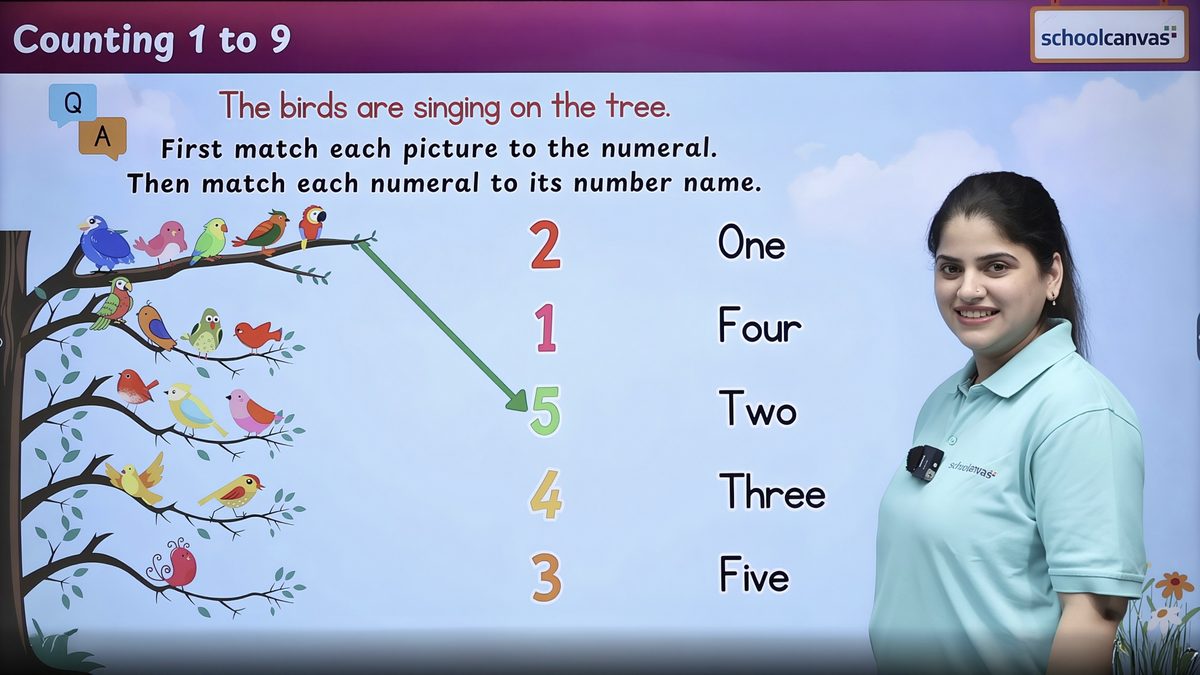
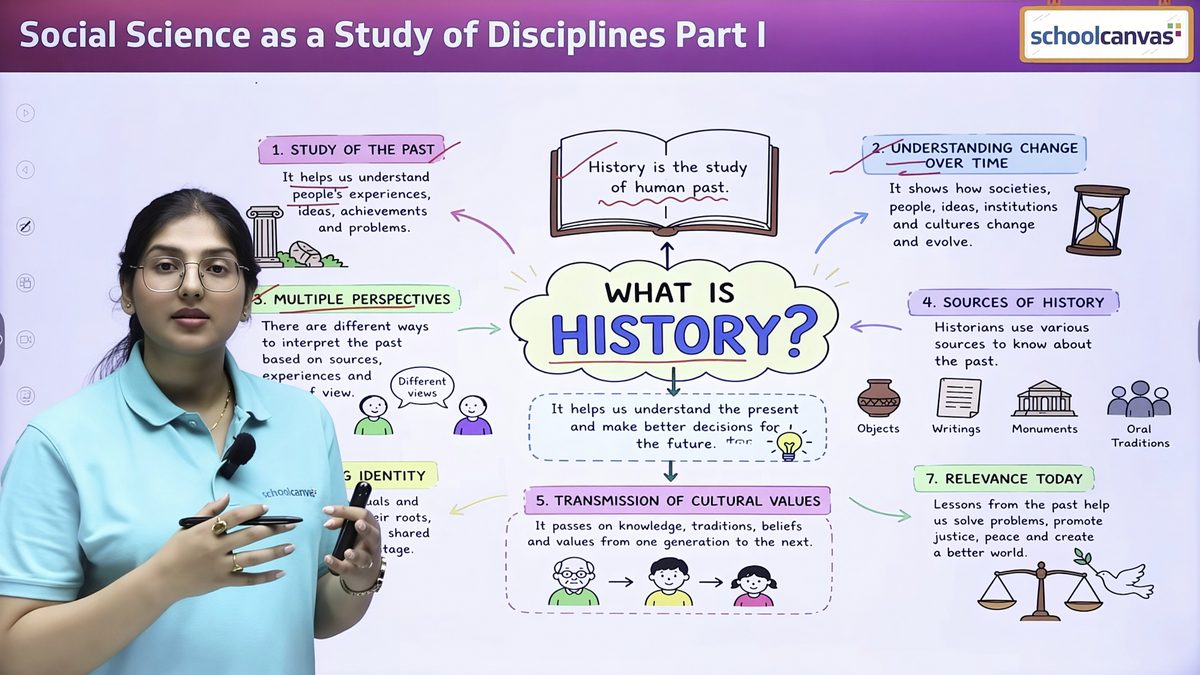

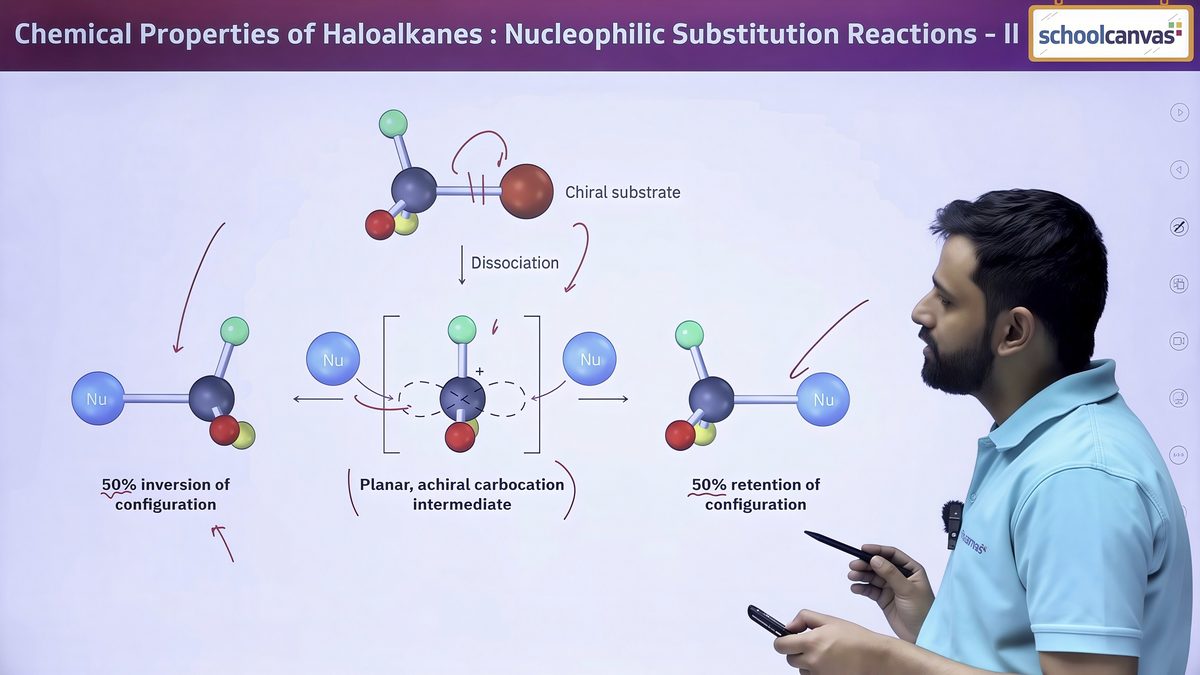
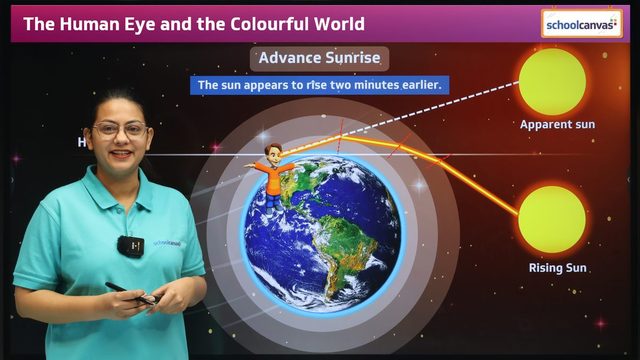
Stills from lessons recorded by the Schoolcanvas academic team.
Questions students and parents ask about Schoolcanvas Learn.
What is Schoolcanvas Learn?
A study app for students in Class 3 to 12. For every chapter you get videos, notes and a quiz, practice that finds and fixes your weak spots, a chapter exam and a revision plan. Guruji, your AI learning buddy, answers your doubts in English or Hinglish.
Which classes and boards does it cover?
Class 3 to 12, for CBSE and ICSE. JEE and NEET preparation is available for Class 11 and 12, for students of any board, including state boards. State board school subjects are coming soon.
When does it launch?
Soon. Leave your mobile number for early access and we will message you the day it opens.
Which devices does it work on?
Android phones and tablets, iPhone and iPad, and the web on a computer.
How does practice find weak spots?
After the lessons, a chapter worksheet checks every concept. For the weak ones, the app gives new questions round after round, never repeating one, until you reach 80%. Then the chapter exam opens.
I have gaps from earlier classes. Will the app notice?
Yes. The chapter worksheets show which concepts are weak and trace them back to the earlier topic behind them, such as negative numbers from Class 7. You get a short refresher on that topic before practising the new one.
Are there live classes?
Yes. Alongside the self-learning videos and recorded sessions, you can join live classes with expert teachers when a concept needs a deeper explanation.
What is Guruji?
Guruji is your AI learning buddy in the app. Snap, speak or type a doubt and get a step-by-step answer, linked to the right part of the video. Guruji can also check your own written working and show you the line with the mistake.
Can Guruji help with homework?
Yes. Snap, speak or type the question. Guruji can give you a hint first and then walk you through the steps, so you understand how to solve it, not just what the answer is.
Can Guruji explain in Hindi?
Guruji explains in English or Hinglish. You can switch with one tap.
Are there JEE and NEET test series?
Yes, for Class 11 and 12. Tests run on fixed dates in the real computer-test pattern, and every test ends with an analysis: time per question, marks lost to guessing and the chapters to fix.
How does the app balance board exams with JEE or NEET?
Every chapter is first done for the boards: videos, notes, a worksheet and a chapter exam with written answers. Then the same chapter is practised in JEE or NEET style, with past-year questions, so one chapter serves both.
My Class 9 and 10 basics are weak. Can I still start JEE or NEET preparation?
Yes. The chapter worksheets show which concepts are weak and trace them back to earlier classes, and the app adds short refreshers before the entrance-level practice.
How are the mock tests marked?
As in the real exam, including negative marking where the exam has it. The test screen shows the marking for every section before you start.
How are chapter tests checked?
Every chapter has an objective test and a subjective test. You answer on paper, scan and upload the sheet, and get your result and feedback straight away, with marks for each point and a full-marks model answer.
Can I create my own tests?
Yes. Choose the concepts, question types, difficulty and skills, and AI builds the test. Create as many as you need.
What language are the papers in?
Papers are in English. Hindi is used for the Hindi subject. Guruji can explain any question in Hinglish.
What happens if the app closes during a test?
Answers are saved as you go. The app reopens straight into the test, and the timer keeps running, as in a real exam.
Do I need a password?
No. You sign in with your mobile number and a one-time code. You can set a password later if you like.
Is there a free trial?
Yes. Every student gets a 30-day free trial.
How much will it cost?
Plans and prices will be shared at launch. Early-access families hear first.
What can my parents see?
Your progress, test results, learning plan, a weekly summary and a monthly report. Your chats with Guruji stay private.
Can two children use it?
Yes. Each child has their own account. A parent can add a brother or sister from Class 3 to 12 and switch between them.
Does my school need to use Schoolcanvas?
No. Any student can use Schoolcanvas Learn. If your school uses Schoolcanvas, chapters follow your class order and school test marks come in.
Be the first to try it.
Leave your number and we will message you the day Schoolcanvas Learn opens. You start with a 30-day free trial, with every subject of your class.
Get early access
Takes 20 seconds. Students and parents can both sign up. We only use your number for Schoolcanvas Learn.